Tailwind Futures Monthly Newsletter

Our Predictions for 2026
What will be the key drivers of demand for adaptation and resilience solutions in 2026? We put our heads together and identified four key trends:
Geopolitics
- Despite public climate denial/skepticism, geopolitics will start to factor in the effect of climate change on strategic national priorities, including Arctic shipping routes and exploration, increasing political conflicts around migrations, and food security.
- Geopolitical fragmentation and trade wars will continue to cause supply chain instability, driving greater interest in onshoring / reshoring solutions, changes to product design/formulation and substitute commodities in particular metals and minerals.
AI
- Datacenters will emerge as key nodes of climate vulnerability and opportunity for resilience tech, as growing demand for energy and water will drive demand for grid resilience, energy storage, energy efficiency, cooling technologies, and water tech.
- In parallel, AI will materialize as an enabler of climate resilience advances, with potential for increasingly sophisticated, hyperlocal corporate and urban climate risk and resilience assessments,expanded vision learning model applications during and after natural disasters, and as an enabler of breakthroughs in health and biosciences.
Insurance
- P&C Insurance challenges will persist, creating opportunities both for alternative risk transfer solutions and technological solutions to asset-hardening, though preference for business as usual practices by mortgage lenders will continue to slow adoption of the former
- With legacy P&C carriers exiting high-risk regions, startups that offer highly-specialized insurance products and distribution channels that allow for breadth, flexibility, and speed of distribution will capture greater market share (e.g. parametric insurance, embedded distribution channels).
Return on Investment
- The ROI of resilience investment will improve due to increasing cost of inaction and cross materiality thresholds for key industries, and a greater understanding of the business case for adaptation investments.
- The World Cup will expose the impacts of changing climate across regions in North America, driving resilience and adaptation investments for businesses in hospitality, travel and entertainment sectors to ensure quality and reliability of service (e.g. cooling centers for outdoor venues, outdoor air filter for wildfire smokes).
Tailwind Futures Welcomes New Managing Partner

Arindam Bhattaharya joins as Managing Partner
We’re thrilled to welcome Arindam Bhattacharya as Managing Partner to the team! Arindam brings over 30 years of global energy industry experience with SLB (formerly Schlumberger) in executive leadership roles covering operations, strategy, technology, innovation, and corporate venture capital. In his most recent role as Managing Director for SLB Ventures Arindam led investments to scale innovation around industrial decarbonization, critical minerals and clean power to support the incubation of the SLB New Energy business portfolio. In prior roles, he led global and regional business units with responsibility for multi-billion$ P&Ls and several thousands of employees, bringing a deep understanding of enterprise dynamics and strategic priorities. Now, Arindam joins Tailwind Futures to scale the next wave of technology and innovation necessary for corporate resilience.

Natalie Ambrosio Preudhomme joins as Principal, Market Insights
We are excited to welcome Natalie Ambrosio Preudhomme to the team! Natalie joins as Principal, Market Insights to lead Tailwind’s thought leadership and communications. She will leverage her background in data-driven analysis and communication of climate risks and resilience opportunities across sectors. Previously, Natalie led climate-related thought leadership at Moody’s Commercial Real Estate business, connecting the dots between climate risk and financial-decision making for CRE investors and lenders. She joined Moody’s through the acquisition of Four Twenty Seven, a pioneering provider of physical climate risk data, where she led editorial strategy and communications.
Market Insights
Impacts of climate change could reduce US corporate operating margins by 2.0 percentage points on average in 2050, accounting for total damages of $1.5 trillion across all US enterprises.
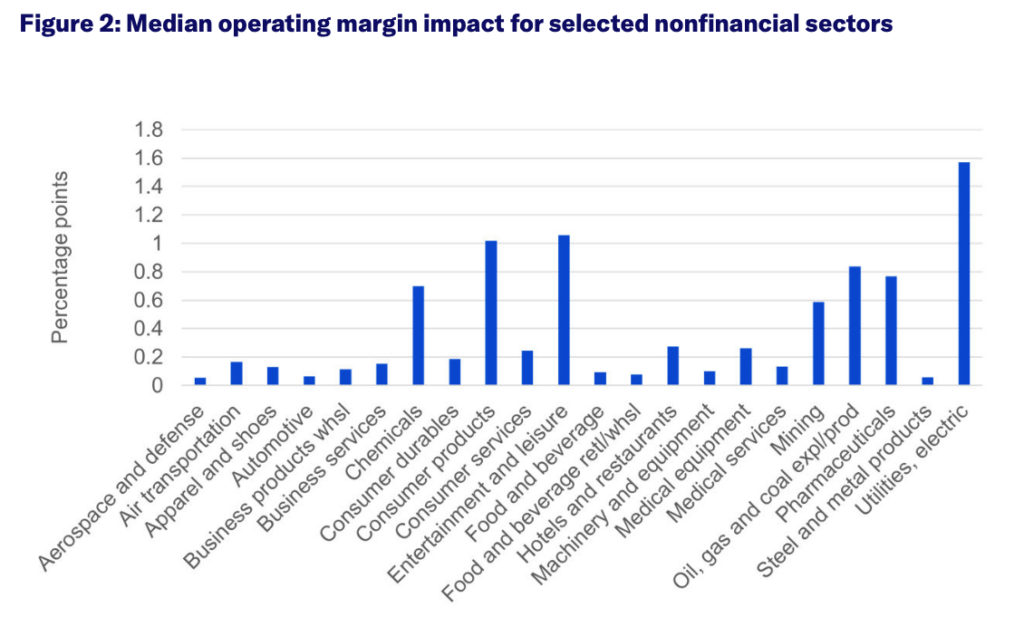
Chart Source: Moody’s
Moody’s report, Catastrophic events in an uncertain future: A pending $41 trillion bill for business and governments to resolve, quantifies financial risk from climate change for businesses and real estate and unpacks the drivers of this risk. Of this overall average reduction in operating margin, 1.47 represents an indirect impact driven by chronic climate hazards (such as sea-level rise, heat-driven productivity declines) lowering GDP, while 0.56 percentage points is the direct operating margin impact that US firms are expected to suffer due to the exposure of their facilities to extreme weather.
The exposure of companies’ facilities to physical perils (high for sectors such as consumer products and chemicals) and their ratio of tangible fixed assets to sales, indicating their level of dependence on physical assets for revenue (high for sectors such as utilities and mining), influence their risk to direct impacts. Firms with both location vulnerability and revenue dependency can greatly exceed the average projected operating margin impact.
While roughly a quarter of the 639 assessed public companies experience only a small operating margin impact from extreme weather damaging their facilities, translating to a reduction of 10 basis points or less, the upper quartile (27%) of firms are severely affected by operating margin reductions of 100 basis points or more. “Profitability impacts of this magnitude represent a significant financial challenge to companies, hurting their ability to service debt, fund growth, and return value to shareholders,” the report notes.
Climate risk is already putting downward pressure on real-estate markets
“‘They won’t insure you,’ Ms. Rojas said. ‘No one will buy from you. You’re kind of stuck where you are.’” The New York Times article, Rising Home Insurance Premiums Are Eating Into Home Values in Disaster-Prone Areas describes the link between declining insurability and asset values quantified in a recent National Bureau of Economics Research report.
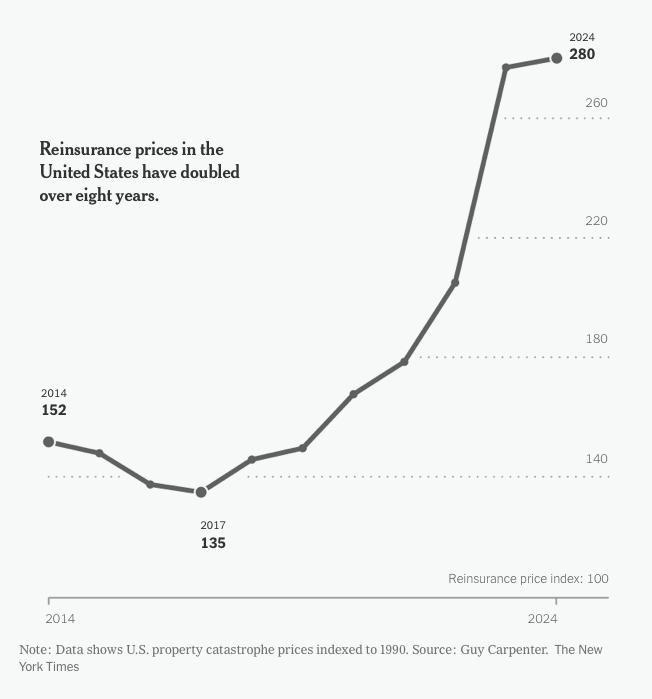
The report studied 74 million mortgage escrow payments across the nation along with the changing prevalence of wildfires and hurricanes. Researchers found that the “increase in the cost of disaster risk explains 20% of the growth in [home insurance] premiums between 2017 and 2024.” Reinsurance costs also inform homeowners insurance premiums and have been on the rise in recent years, also influenced by destructive weather, in addition to construction costs and other economic factors. The report found that rising insurance rates had negative impacts on home values.
Real estate challenges are not specific to residential properties, as commercial real estate portfolios have also experienced significant insurance challenges in recent years, and face growing losses from extreme events. In the report above, Moody’s modeled a typical commercial real estate loan portfolio under the “no new decarbonization policies” scenario and identified a “near 18% increase in default probability and about a 20% increase — more than $200 million — in expected losses” in 2050.
Technological innovations can help mitigate cascading insurance challenges
Insurance coverage during a disaster, as well as the potential for future coverage, influence the rate of rebuilding, with implications for the long-term viability of communities. These dynamics are currently unfolding in Los Angeles, where homeowners grapple with challenging decisions a year after the devastating fires.
These losses ripple through the financial system, affecting mortgage lenders in addition to building owners, tenants, developers and insurers. Emerging firetech and insurtech solutions can help these players not just refine their understanding of climate risk’s financial impacts but embrace innovative approaches to both pricing this risk and mitigating it. For example, tech companies such as Wuuii and Xyloplan offer innovative risk quantification models for insurers in high risk locations, while technologies like Seneca’s autonomous rapid response drone fire suppression systems could revolutionize the way assets are protected.
Fellowships, Accelerators and Prizes
- Female founders in tech – check out the VivaTech Female Founder Award. Applications are open until February 2nd!
- The Strauch Cleantech to Market Program (C2M) at UC Berkeley helps accelerate the commercialization of leading cleantech solutions. Selected C2M startups work at no cost with 4–6 UC Berkeley graduate students, whose work is supervised and reviewed by program faculty, and are eligible to win up to $40K in award funding. Are you an early-stage climate startup looking to accelerate your go-to-market strategy?
- Applications are open. Application deadline: February 22, 2026
- Building a solution for climate-resilient and sustainable chemicals manufacturing? You may be a fit for Go Make 2026, an innovation program hosted by Greentown Labs in partnership with Shell and Technip Energies. This open-innovation program is for startups that are developing process technology and catalytic innovations for low-carbon fuels, low-carbon gases, CO2 removal, and sustainable chemical manufacturing.
- Application deadline: March 10, 2026
- Third Derivative and RMI are looking for innovative passive daytime radiative cooling (PDRC) technologies to pilot solutions on informal housing in Ahmedabad, India or commercial buildings in the United States. Both opportunities offer participating manufacturers the chance to deploy their products, gather data, and get early exposure with major asset owners quickly with fewer financial barriers.
- Learn more about the opportunity and apply here!
- The SAP and Top Tier Impact Global Water Challenge is still looking for the best innovations in water efficiency and resilience. They will also host a Davos event on water resilience & efficiency at the World Economic Forum. You can nominate a startup or submit your own startup here.
- The newly-launched InnSure Creation Labs Accelerator is seeking early to mid-stage growth companies with impact-focused, innovative risk transfer, technology and/or data solutions in risk management. Reach out here.
- Startups in Canada, keep an eye out for the MaRS Discovery District and Definity AdapTech Accelerator. Applications opening in 2026.
Upcoming Events
- Jan 21-23: Power Resilience Forum – Houston, TX
- Is your organization planning an event focused on adaptation and resilience? Do you have new research or work you want to highlight? Do you want to host events focused on enhancing resilience in the face of extreme weather changes? Let us know here:https://lnkd.in/ei-GJXyp
- More details on our calendar of events coming soon!
- Jan 26-28: Cleantech Forum North America – San Diego, CA
- Arindam Bhattacharya, Managing Partner, will attend.
- Jan 29: The Last Mile of Climate Risk: Translating Analytics into Financial Resilience – San Francisco
- Emilie Mazzacurati will be speaking on the future of climate adaptation & resilience across the financial sector.
- Feb 9-11: Manifest: The Future of Supply Chain & Logistics – Las Vegas, NV
- Osama Idrees will be attending.
- Mar 24-26: Global Corporate Venturing & Innovation Summit – Monterrey, CA
- Emilie Mazzacurati and Arindam Bhattacharya will attend on behalf of Tailwind Futures.
- March 30-31: Insurtech NY Spring Conference – New York, NY
- Brooke Zhang will be attending. (See discount code above)
- Mar 30-Apr 1: ChangeNOW – Paris, France
- Emilie Mazzacurati will be attending
- Apr 8–9: ClimateTech Connect – Washington, DC
- Brooke Zhang and Katie MacDonald will attend.
- Apr 18-26: SF Climate Week – San Francisco, CA
- Keep an eye out for our schedule of events!
- Apr 20-26: DC Climate Week
ClimateTech Connect Event Discount
Tailwind Futures is proud to partner once again with ClimateTech Connect, “Where Climate Resilience Meets Technological Innovation” at its annual flagship conference April 8th-9th 2026 in Washington D.C.
Click here to register and use code: tailwindVIP for 25% off ticket prices.

Did someone forward you this email? Sign up for Tailwind Futures’ newsletter here!
Pitch us! If you’re a startup founder or operator, learn more about our investment thesis and fill out this form to start a conversation.