

Universities are a treasure trove of innovation and their breakthroughs have paved the way for advances in infrastructure, medicine, manufacturing and other industries for decades. Yet much of this research remains untapped, hidden away in research papers and labs.
Our recent report, Resilience Game Changers, explores this challenge and the opportunities to better harness academic research to scale resilience solutions. We unpack five breakthrough technologies with resilience applications across industries and examine their commercialization journeys. As part of this initiative to bring more university-originated research to market as resilience solutions, we co-hosted the event “From Lab to Market: Accelerating Adaptation and Resilience Technologies from Universities” to explore success stories, ongoing challenges and emerging solutions, with a diverse group of stakeholders, including founders, university researchers, technology transfer offices, investors, accelerators and other ecosystem builders.
We hosted the event during Climate Week NYC 2026 at Cisco, co-hosting with Activate, Foley Hoag, the Hazelwood Network and The New York Climate Exchange. We share highlights from the opening presentations and three panels below.
Identifying resilience-relevant research at universities
Tailwind Future’s Emilie Mazzacurati kicked off the event introducing the updated Tailwind Adaptation & Resilience Taxonomy which provides a lens for researchers to see how their research might support resilience and which industries may be interested in related solutions. It outlines eight themes, with 36 underlying sectors and breaks solutions into six buckets: digital solutions & analytics; sensing & autonomous technologies; advanced materials & engineered solutions; nature-based solutions; finance & insurance solutions; and services.
Many researchers don’t frame their work around climate, but could qualify for additional grants and support programs if they applied for resilience related programs. This connects to the first barrier to scale Victoria Salinas, Climate Leader in Residence at Duke University, identified in her keynote remarks: promising research does not automatically become a usable solution. Identifying the resilience needs across industries helps identify the solution that the research may inform.
Victoria outlined three other barriers: a usable solution isn’t automatically investable, something investable isn’t necessarily procurable and even if it’s procurable it doesn’t automatically scale. While procurement came up throughout the day as a persistent challenge, Victoria provided an example where procurement enabled scale. New York City identified deaths from extreme heat as a challenge and issued specs for non-disruptive install cooling units, which catalyzed new solutions from a range of providers, ranging from global firms to startups.
Victoria’s final message became another motif throughout the day: each person in the ecosystem has a superpower, so identify that superpower and where it fits in the journey from lab to market, and then connect it to others’ in that journey.
Harnessing Universities not Just as Researchers but as Partners
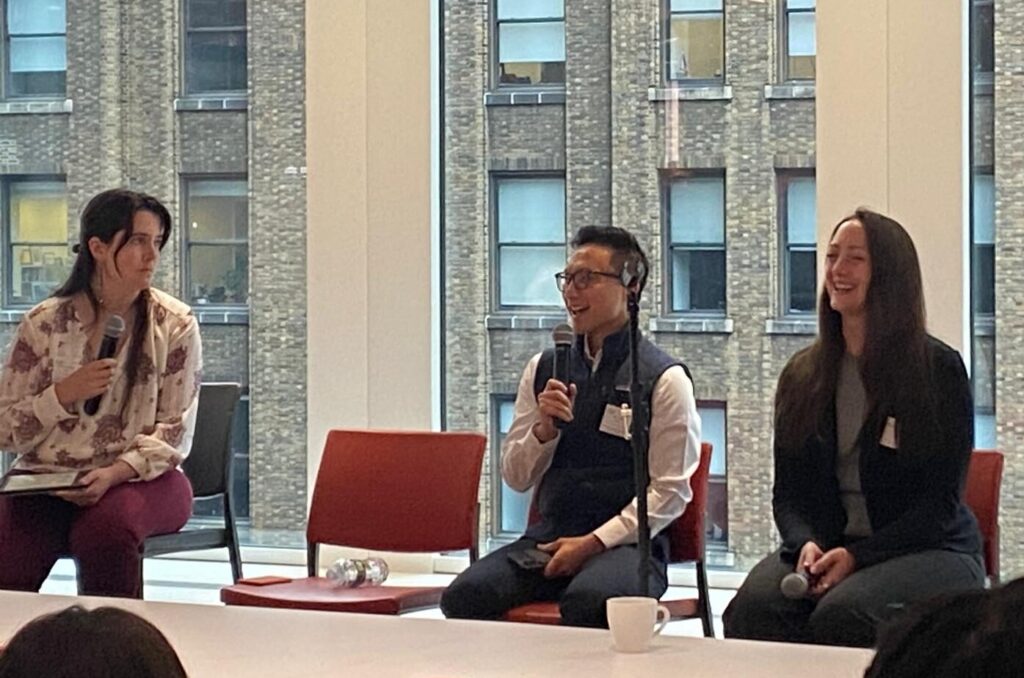
Tailwind Futures’ Natalie Ambrosio Preudhomme moderated the day’s first panel, “The Road from Initial Research to Commercial Traction for Passive Cooling Techs,” with speakers from across the lab to market value chain, including Emily Dinino, Founder & CEO of ThermoShade, Marcus Leung-Shea – Head of Living Labs Program, The Hong Kong University of Science and Technology and Adam Jaffe, Associate | Specialist Technology Analytics + Research at Arup. Speakers highlighted the importance of technical literacy and product market fit. (Image from left to right: Natalie Ambrosio Preudhomme, Marcus Leung-Shea and Emily Dinino)
Adam described his introduction to passive daytime radiative cooling (PDRC), excited by the Stanford material science breakthrough that enables cooling in direct sunlight with no energy inputs. But he also described the importance of digging into the science to understand its realistic applications. Vetting the technology with the potential market in mind can save months and capital that can be wasted with a misaligned product and market. For example, Marcus described Singapore as tall and skinny, with cloudy skies, making it less ideal for PDRC. Meanwhile, with knowledge of the technical specs Emily’s team designed a cooling panel that combines phase change material with PDRC in a cooling structure that stays cool even in cloudy skies.
The panel’s final take-away focused on the value of universities, not just as a source of new research but also as a valuable partner in the full journey from lab to market. Hong Kong University of Science and Technology’s Living Labs program provides a low-risk opportunity for researchers to pilot new technologies on site, on the universities’ buildings. It also pairs faculty with startups in separate industries, where IP is not a concern, so researchers can get exposure to the commercial space and test out their new tech.
ThermoShade has partnered with Cornell Dryden Farm and Fresno State dairy to test its cooling panels for livestock, establishing commercial validation. Adam noted the mutual benefits that a global industry partner like Arup and a university researcher or spinout bring, when filing jointly on grants or patents.
Customer Discovery Unlocks Multiple Pathways to Scale
The investor panel moderated by Dexmat CEO Bryan Hassin, featured a range of investor perspectives, including Managing Partner of Cisco Foundation’s Regenerative Future Fund, Jocelyn Matyas, Azolla Ventures Co-Founder Johanna Wolfson and Tailwind Futures’ Founding Partner Emilie Mazzacurati.
Panelists emphasized that founders should interview dozens or hundreds of potential users to hone in on the optimal beachhead market. Many A&R solutions have public benefits with potential government buyers, such as cooling panels on bus stops, or copper alternatives for NASA equipment. However, public procurement has long timelines, often multiple years, which makes it challenging to scale a company. Finding a private sector beachhead (such as ThermoShade’s dairy use case discussed above), allows for pilots and capital in the near-term, while founders foster relationships with public sector buyers to which to sell a more established product when available.
The investors noted the strong signal that university IP provides for a startup, quickly establishing analytic rigor and cutting-edge technology. However, when it’s time to raise capital, sales capability is also essential. Startups rely on founder-led sales before they’re ready for a sales team, so partnering with a commercially-minded co-founder, or making a sales executive hire early is crucial.
Another strategy for founders is to position the company to receive a range of funding. Non-dilutive grant funding is a great addition to VC capital. Meanwhile, companies could structure a research/data arm into a nonprofit while the commercial entity remains the investible vehicle. This allows the company to earn grants from philanthropic funders who can’t invest in for-profits. Azolla’s climate commitment is split between impact investments to for-profits and grants to nonprofits, for example.
Strengthening the Seams in the Journey from Lab to Market
The “Ecosystem Enablers” panel featured Jamil Wyne, Founder of the Hazelwood Network, Jesse Lou at RecursionWorks / TEA Commons, Christina Escoda, Managing Director at Activate, Lucas Watkins, Partner at Foley Hoag, and Shaina Horowitz, Director of Program Innovation & Acceleration at The New York Climate Exchange. Focusing on the problem rather than the solution emerged as a key strategy for identifying the right demand. For example, demand isn’t framed as “solve extreme heat” but rather as “protect my workers,” in the case of wearable heat tech. Jamil noted that these problems are emerging in real time and growing in urgency. To improve early product market alignment, Shaina suggested forums for government and industry representatives to reverse pitch their needs to researchers and founders who can then see where they can harness their research and design products to solve an industry need.
Meanwhile, conducting techno-economic analysis (TEA) helps founders stress test their commercialization assumptions, and identify what levers can close any gaps (such as more R&D, a different market or cost reduction). Jesse emphasized the value of a TEA for the founder and company, not just as a requirement from investors.
Christina described the mindset shifts of scientists who transform into founders, which Activate strives to support: risk tolerance changes from the scientific mindset of certainty to the founders’ need to move quickly with good-enough decisions. The need for adaptive, creative storytelling overrules the demand for esoteric dialogue. Meanwhile there is no consistent pipeline of talent, but rather top talent must be recruited. And lab time shrinks while relationship-building monopolizes time.
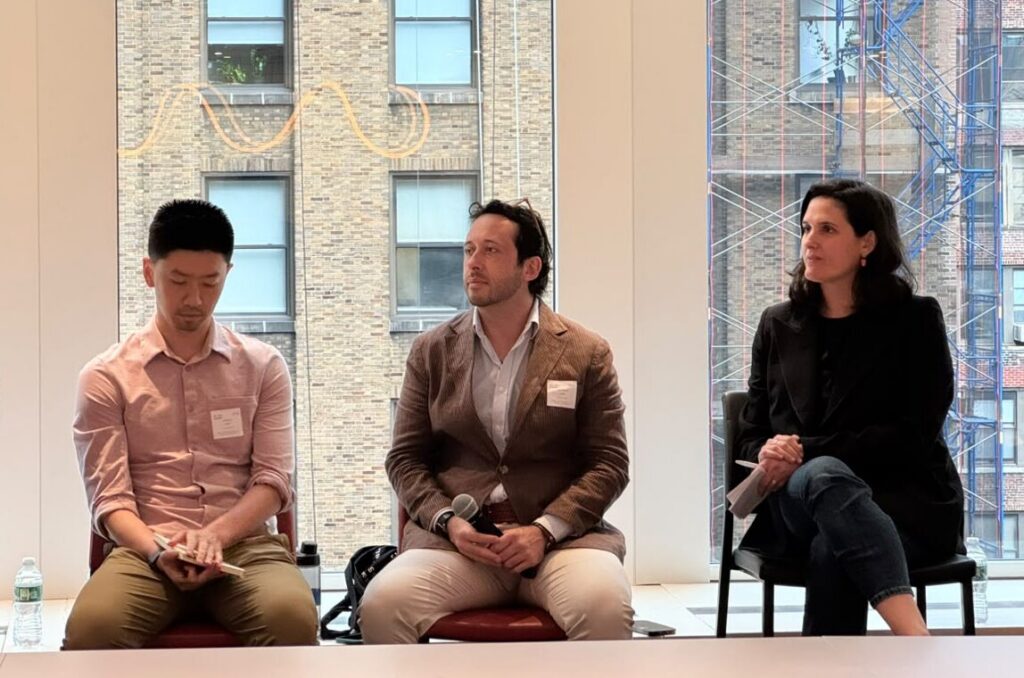
Panelists emphasized the gaps in the handoffs, particularly later stage adoption by corporations. The panelists’ closing comments focused on ways to close those gaps, “strengthening the seams,” and harnessing those superpowers Victoria highlighted at the beginning. University IP hold great power when used strategically. One approach is for entrepreneurs to partner with non-founder academics who want to focus on the IP. Meanwhile panelists raised the opportunity for universities to develop hard-tech specific licensing structures. (Image from left to right: Jesse Lou, Jamil Wyne and Shaina Horowitz)
When building the ecosystem and improving collaboration, Jamil encouraged everyone to adopt the long-game mindset, “building cathedrals that you won’t see finished,” but that will accelerate lab to market momentum for A&R technologies over time.
University research is critical to unlocking novel approaches to futureproofing buildings, infrastructure, manufacturing and supply chains. It lays the foundation for technologies that enable physical, strategic and financial resilience. Understanding early stage research and monitoring spinouts is essential to Tailwind Future’s work both to identify the next frontier of tools helping businesses build resilience and to help scale the resilience innovation ecosystem. Reach out to us if you’d like to discuss how resilience tech presents a competitive advantage and opportunities to improve the pathway from lab to market.