
Canadian Playbook
The Canadian Adaptation Innovation Playbook
MaRS Discovery District and Tailwind Futures are proud to present the Canadian Adaptation Innovation Playbook, a report establishing a baseline for Canada’s emerging “adaptech” sector. The Playbook maps public and private demand alongside startup activity and capital stack to identify where climate risk awareness is – and is not – translating into investable demand and scalable solutions. The findings presented have implications for both the private and public sectors, signalling where action on the adoption, investment, and supply side is needed.
Download the Canadian Playbook, read highlights below, or watch the webinar and view its slides.
Government Demand
We estimated 2024 spending on climate adaptation or resilience initiatives across all three levels of government, in Canadian dollars, finding:
- $1.22 billion in federal spending
- $995 million in provincial and territorial spending
- $1.30 billion in spending from six large municipal governments
Corporate Demand
We reviewed public disclosures from 27 of Canada’s largest publicly traded companies, across eight sectors with high exposure to physical impacts from climate change, finding that awareness was high, but quantified and disclosed spending on adaptation was low:
- 96 percent of assessed companies recognize climate change as a material threat
- 86 percent conduct climate hazard scenario analysis
- 15 percent have a formal adaptation plan
- 11 percent disclose quantifiable spending on adaptation
Consumer Demand
Consumer demand for climate adaptation is challenging to track and quantify, as it is the aggregate of many purchases, which cannot always be directly attributed to climate change. While not comprehensive, we reviewed recent reports providing insight into demand from Canadian consumers:
- 23 percent of Canadians have personally been affected by extreme weather between June 2024 – June 2025, according Canadian polling firm Leger.
- The Canadian Climate Institute estimates that climate-related damages increase the average household cost of living by about $700 per year.
Supply
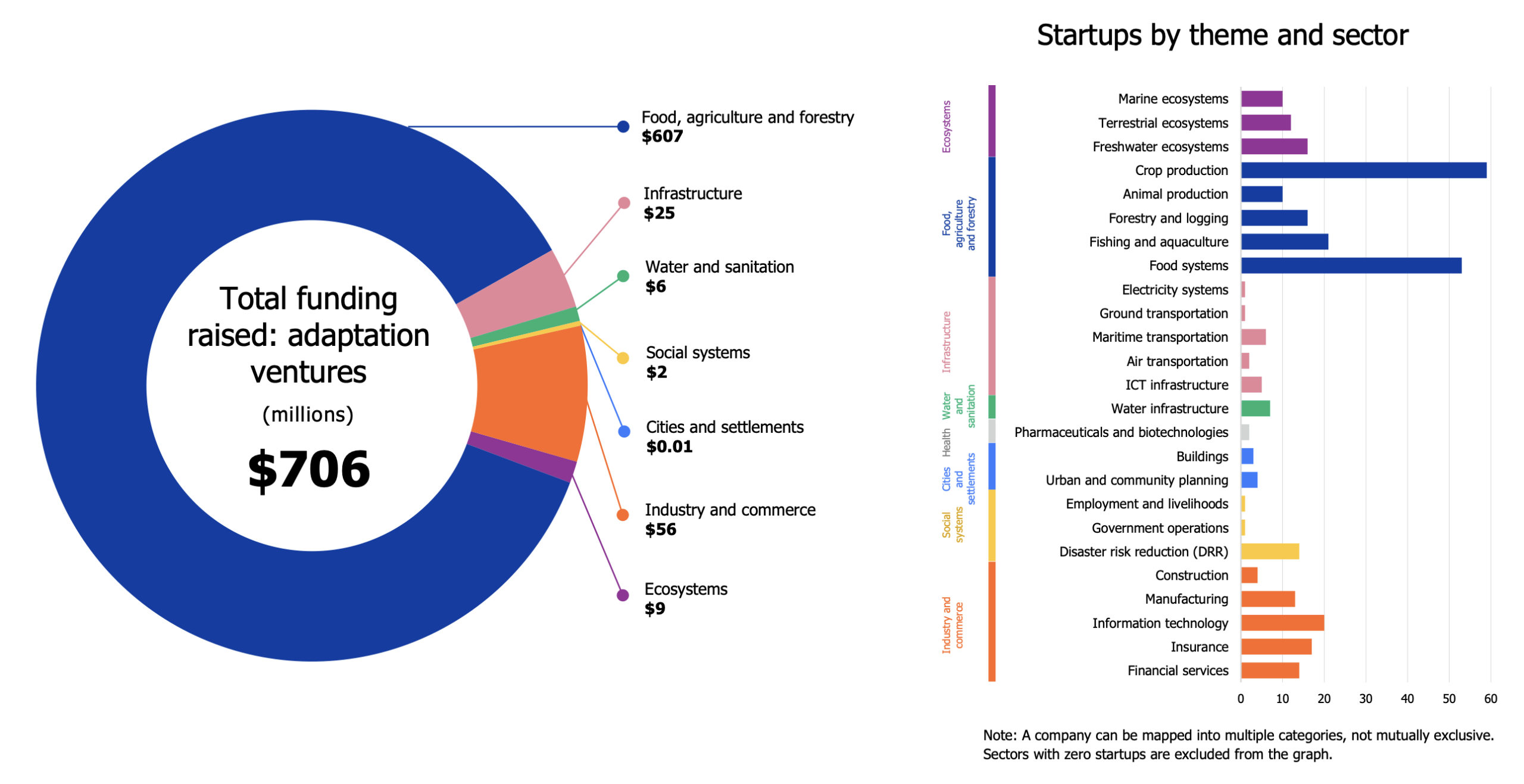
- Pure-play adaptation startups account for 10 percent of all funded Canadian climate startups, but receive only four percent of total funding.
- Dual-benefit startups, with both adaptation and mitigation benefits, accounted for 25 percent of all Canadian climate-relevant startups and receive about 21 percent of total funding.
- Within pure-play, Food, agriculture and forestry startups received 85 percent of total capital raised, while Cities and settlements; Water and sanitation; and Ecosystems account for under 3% of total capital raised.
- The supply analysis was developed in partnership with Vibrant Data Labs.
Capital Stack
We assessed dollars invested by startup stage to understand gaps in the capital stack, finding:
- For pure-play startups capital is concentrated at later stages, with 13 deals accounting for over 60 percent of total dollars invested.
- While pre-seed and seed-stage deal counts are high, there is a sharp drop at early stage, revealing a funding gap between validation and scale for pure-play startups.
- For dual-benefit startups, capital is distributed more evenly across the stages.
Recommendations
The report outlines recommendations for different market participants to support the development of the resilience innovation economy:
Funders
- Support tools for measuring impact to help develop a clearer picture of demand for adaptation solutions
- De-risk commercialization by supporting pilots and testbeds with cities
- Focus on two identified capital caps:
- Capital Gap #1: pre-seed to seed outside of the Food, agriculture and forestry sector
- Capital Gap #2: early venture to later stage
Innovation Adopters
- Improve visibility of adaptation demand and partner with innovators to accelerate proof of concept
- Be conscious of maladaptation risks
- Corporates: understand climate risks, invest in line with risk exposure and disclose related investments to strengthen the demand signal and inform innovation
- Public sector actors: reduce procurement friction which can hinder the adoption of new technologies and aggregate procurement calls across regions facing similar risks, to accelerate the scaling of solutions
Entrepreneurs
- Focus on untapped areas, where there is need or demand that hasn’t yet translated into supply
- Frame the benefit of the solution in terms that appeal to potential adopters and funders, and collaborate across the ecosystem
Policy-makers
- Mandate adaptation tagging and disclosure of climate risks, governance and adaptation spending and serve as a role model of best practices
- Adjust procurement practices to foster adoption of innovative tools, and align priorities and standards across all levels of government
- Fund programs across the full innovation pipeline and ensure programs include community engagement elements and foster equitable resilience
Citations
This work should be cited as: MaRS Discovery District and Tailwind Futures (2026). The Canadian Adaptation Innovation Playbook.
Download the Canadian Playbook
Contact Us