

Climate risk in commercial real estate is uneven, site-specific, and challenging to quantify. Yet it is a critical driver of growing operating expenses. Fast-growing wildfires made up just 2.7 percent of fires across the Western United States between 2001 and 2020, yet destroyed 88 percent of the homes lost in that period. Charleston, South Carolina now records around 14 high-tide flooding days a year, up from roughly two in 2000. Power outages drive tens of billions of dollars in annual U.S. losses, reaching $121 billion in 2024. Exposure to these impacts is heterogeneous, presenting an opportunity for owners to identify risk exposure and prioritize retrofits based on the needs at a specific property.
Below we share highlights from Built to Last, the half-day session Tailwind Futures convened on April 22 during San Francisco Climate Week, co-hosted with Arup, Class 3 Technologies, and Morrison Foerster, that examined these themes. Investors, engineers, insurance innovators, and public-sector leaders worked through the same practical question from different angles: how do owners actually underwrite the return on climate resilience investments? Watch the recording of our opening remarks.
Physical risk is showing up in NOI, at exit, and in liability
JLL’s Shaler Campbell walked through how climate exposure is eroding net operating income (NOI) via higher maintenance costs, reducing exit values in repeat-event markets, widening insurance gaps, and pushing liability onto designers and owners. His practical recommendation, drawn from the Climate Risk Management Playbook he co-authored with ULI, the Resiliency Company, and Ryan Companies, is to embed climate risk into the underwriting process and bring insurers into the deal at day one rather than after the design is frozen. That shift transforms resilience investment from a retroactive cost into a design-stage lever that can lower insurance premiums over the life of the asset. Watch the recording of the discussion with Shaler.
Identifying and implementing potential benefits during the design phase allows initial resilience investments to earn their return across the hold period, through lower premiums, higher NOI, and a tighter exit. This also highlights the growing market opportunity for technological innovation that enables the assessment of resilience options, implementation of retrofits and transfer of remaining risk, which the day’s following panels unpacked.
Engineering-grade data makes the retrofit pay off on paper
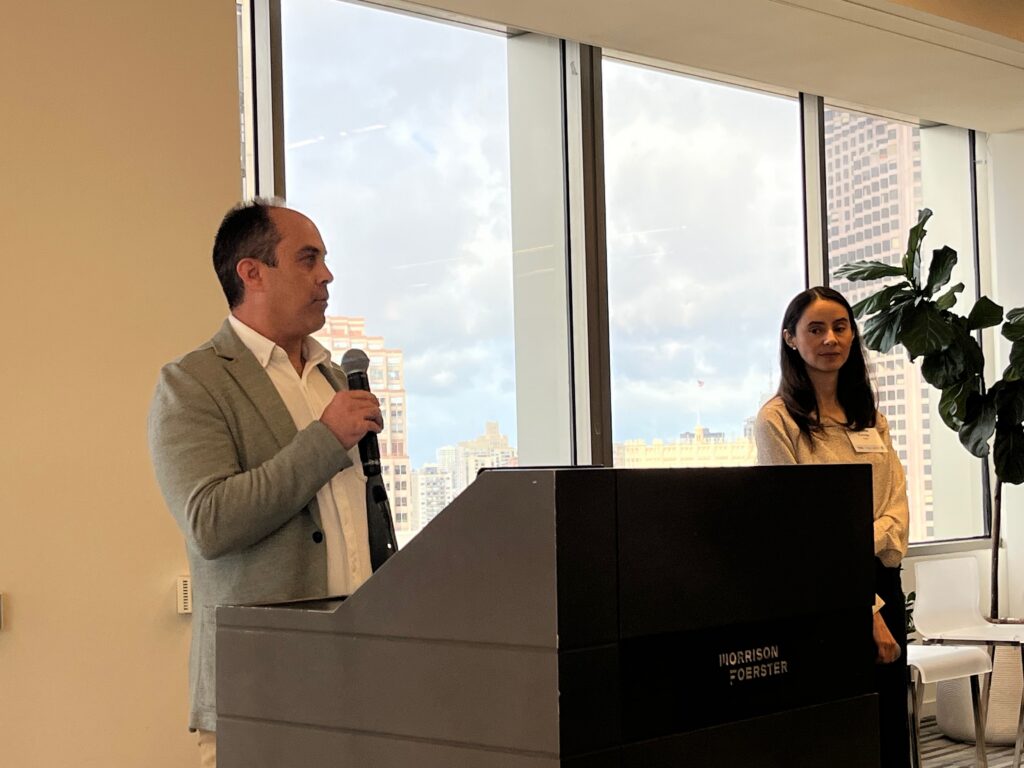
Ibbi Almufti of our portfolio company Class 3 Technologies and Daniela Zuloaga Romero of Arup demonstrated how Class 3 Technology’s Iris platform quantifies exposure and vulnerability at the individual building-component level. Owners can model how a specific intervention, like a stormwater upgrade or a strengthened roof connection, changes expected probability of loss, downtime, or repair cost. In one case study, a stormwater redesign cut a coastal asset’s average annual flood downtime from 4.3 days to 0.04 days and moved it from a high-risk to a low-risk profile in Iris, producing the before-and-after numbers needed to defend the retrofit to an investment committee. Watch the recording of Ibbi & Daniela’s presentation.
Figure 1. Ibbi Almufti of Class 3 Technology and Daniela Zuloaga Romero of Arup
Brian Glazer of our portfolio company Hohonu showed why granular data matters for property owners and asset operators. NOAA’s National Water Level Observation Network covers fewer than 300 tide gauges across more than 95,000 miles of U.S. tidal shoreline, which leaves most coastal assets relying on forecasts too coarse to act on. A regional “10 percent chance of moderate flooding” alert is useless to an owner who needs to know whether her loading dock will be underwater on Thursday.
Hohonu closes that gap with low-cost sensors, deployed by the dozen. Boston Emergency Management uses the data in real time to close flooded intersections and reroute ambulance traffic. In Lee County, Florida, a Hohonu sensor mounted to a downtown Fort Myers traffic light captured water depth at the intersection during a direct tornado hit, fifteen miles from the nearest federal gauge. This type of point-source resolution can also serve as a parametric insurance trigger tied to observed water at a specific asset. Watch the recording of Brian’s presentation.
XyloPlan‘s Scott Cheeseman added the wildfire dimension, explaining his team’s physics-based wildfire models built for fire agencies, property owners, and insurers. The tool is organized around “mitigation pods,” which are clusters of correlated risk bounded by non-burnable features like golf courses, wide roads, and athletic fields. That structure lets owners and agencies prioritize where hardening dollars go first, and gives insurers a defensible way to price the risk a single parcel carries as a function of neighboring risks and risk mitigations. For a commercial owner on the edge of a community, this helps identify how wildfire resilience measures implemented by the broader neighborhood contribute to the commercial property’s risk profile.
Insurance innovation is closing the gap between resilience investment and premium costs
Holly Neber of AEI Consultants noted that according to recent ULI and Heitman research, roof age is one of the most influential building characteristics determining insurance premiums. She also shared ULI’s CRE Guide to Natural Hazards and Property Insurance Underwriting which examines how owners can use the knowledge of which property features influence insurance premiums to inform capital planning for resilience investments. Lastly, Holly highlighted the importance of providing as much information as possible to the insurers and ensuring that it’s up-to-date. In Holly’s illustrative case study a multifamily owner was paying roughly a million dollars in excess annual premium because of a data error on a single submittal.
Figure 2. The insurance innovation panel featuring Holly Neber, Cole Mayer, Mike Gulla and Scott Cheeseman (from left to right)
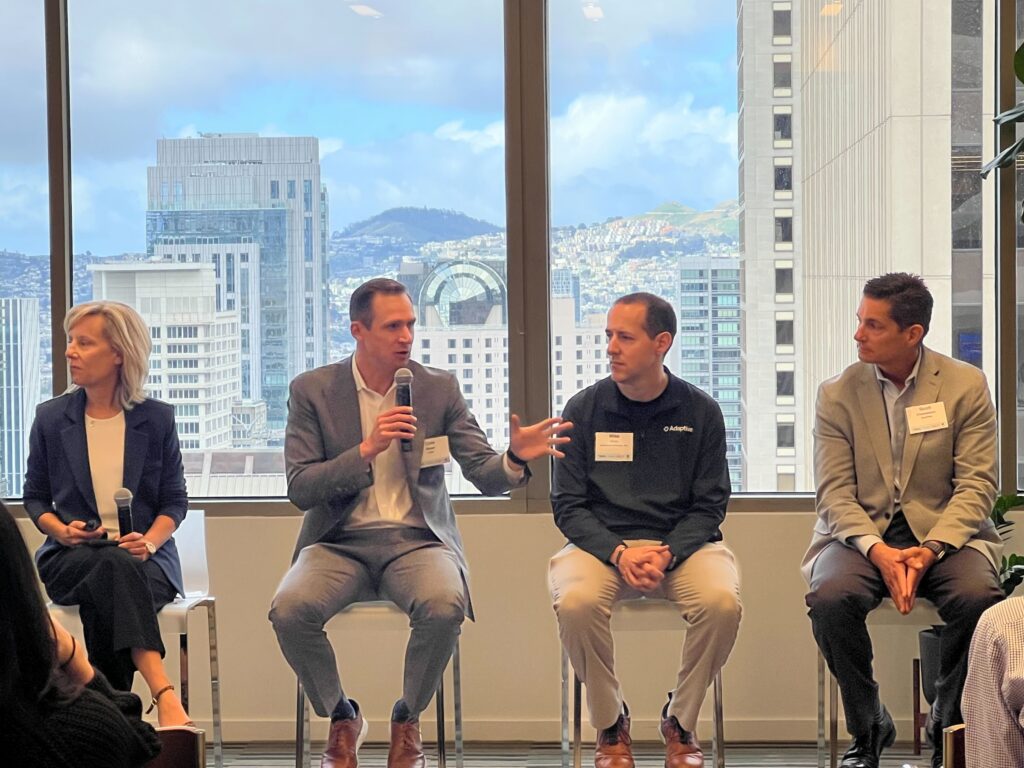
Cole Mayer of Aon and Mike Gulla of Adaptive Insurance described how parametric coverage, which pays out against a pre-defined trigger rather than a post-loss adjustment, fills gaps that traditional products cannot. Gulla calls it “if-then insurance”: if the event hits the trigger, the capital arrives in days, and the insured can use it for any legitimate financial loss tied to the event. The mechanism is especially powerful for risks traditional policies exclude or underprice, such as short duration power outages or non-physical-damage business interruption. For example, coverage that would benefit the Manhattan restaurant on the 30th floor that lost four days of revenue during Sandy because the streets were flooded, even though the unit was untouched. The takeaway we left with is that parametric insurance can be is a useful tool in the risk mitigation toolbox and cost benefit analysis. Sometimes it can be more cost effective to transfer risk than invest in physical mitigations. For example, when debating the purchase of an additional backup generator, a business owner may find that the same level of financial resilience to disruption is available at a lower cost through the purchase of a parametric insurance policy. Watch the recording of the Insurance Innovation for Commercial Real Estate panel, featuring Scott, Holly, Cole, and Mike.
Community-scale resilience closes the gap individual action cannot
Clay Kerchof of the California Department of Housing and Community Development captured the stakes in one line: “an uninsurable home is not an affordable home.” Nor is an uninsurable asset one that can be financed, since without insurance there are no mortgages. Clay’s team is rebuilding post-disaster homes to the Insurance Institute for Business & Home Safety (IBHS) Wildfire Prepared Home Plus standard and piloting community-scale insurance structures so that neighborhood-level risk reduction can translate into insurance premium relief for the households that need it most. Such public-private frameworks and insurance innovations are invaluable in building more resilient insurance industries and real estate markets upon which communities and businesses depend. Watch the recording of the fireside chat with Clay.
Wrapping it up: Technological innovations are helping to price and implement resilience solutions
The morning made it evident that resilience decisions in commercial real estate are increasingly priceable. From component-level vulnerability models and point-location sensor data to community-level wildfire correlations, new technologies are providing data that directly informs design decisions and capital planning. Many insurance companies are now eager to discuss risk mitigation measures and bringing them in early helps everyone understand how best to mitigate risk and improve returns. Meanwhile innovative insurance solutions can combine with improved measurement technologies to cover risks that are otherwise challenging to insure.
—
Tailwind Futures is an investment firm and ecosystem builder focused on resilience technology. Reach out to us if you’d like to discuss technological innovations for building resilience in commercial real estate.