
The Maladaptation Diligence Toolkit provides practical resources to help private investors actively screen for and manage maladaptation risk in their portfolio, filling a gap not addressed by current frameworks.
The Toolkit includes:
- A detailed educational Primer on Identifying Maladaptation Risks in Climate Adaptation & Resilience Solutions.
- Short on time? Read our Executive Summary.
- A Maladaptation Due Diligence Questionnaire (Excel and Google Sheets) to help investors perform pre-investment diligence, and engage with their pipeline and portfolio companies on potential maladaptation risks. It includes case studies bringing the guidance to life.
- The DDQ is also available as a Maladaptation Screener AI tool, leveraging AI models to take a first pass at the questionnaire. This can help users spend more time thinking through the answers and their implications and less time transferring data points from company materials.
Watch the recording of the webinar with the lead authors of the toolkit, Brooke Zhang and Katie MacDonald.
What is Maladaptation?
Maladaptation refers to “actions that may lead to increased risk of adverse climate-related outcomes, including via increased greenhouse gas emissions, increased or shifted vulnerability to climate change, more inequitable outcomes, or diminished welfare, now or in the future. Most often, maladaptation is an unintended consequence” (IPCC AR6 2022).
Maladaptation risks are not about bad intentions. While maladaptation can occur in any adaptation project, it manifests differently in venture-backed companies, where elements such as go-to-market pressures, growth expectations, and IP considerations shape where and how maladaptive outcomes can emerge.
Because adaptation decisions are made under uncertainty, trade-offs are often inevitable, and there may not be a single, ideal adaptation solution. However, maladaptation risks, when identified early, are frequently manageable and addressing them can ultimately improve the solution and investment outcomes.
Four Types of Maladaptive Outcomes
The Primer unpacks four key types of maladaptive outcomes, including activities that:
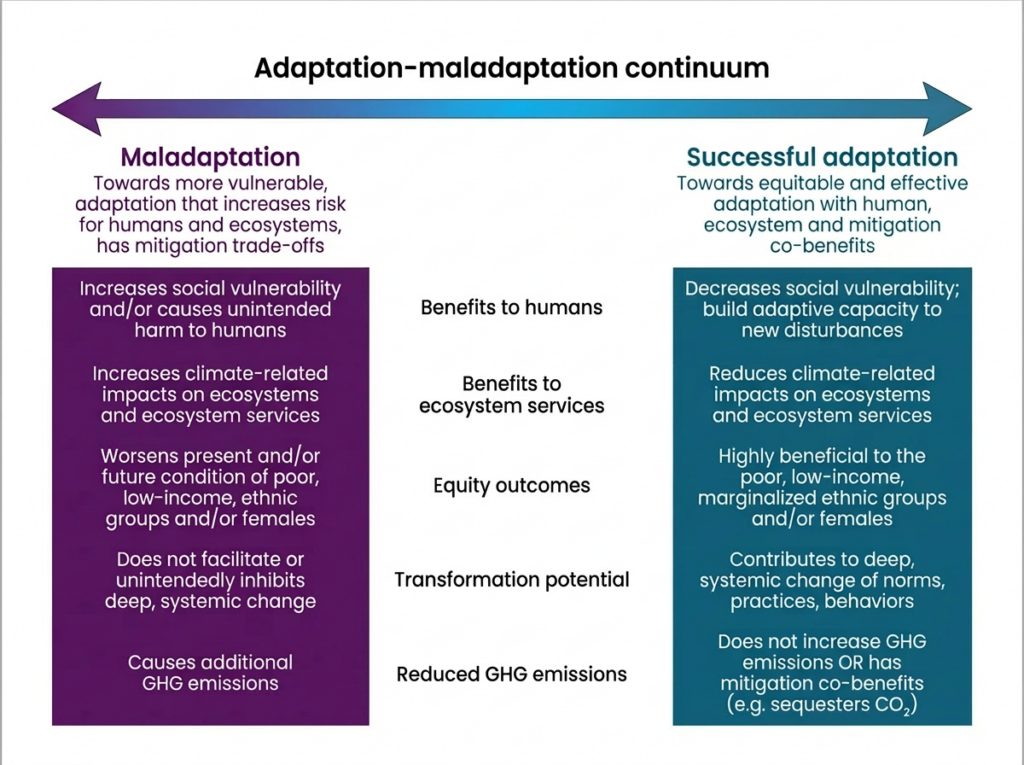
- Inhibit socioeconomic progress related to financial access & livelihoods, social & community; health, safety & security; and conditions for historically marginalized groups
- Increase climate-related ecosystem/biodiversity impacts, related to conservation or restoration efforts and sustainable management
- Inhibit systemic change and/or adaptive capacity related to increased exposure or sensitivity to impacts; increased severity of hazards; new risks to the system
- Materially increase GHG emissions, by substantially increasing demand for energy in a carbon-intensive system or promoting carbon intensive activities
Context Matters
In most cases, maladaptation is not intrinsic to a technology but rather depends heavily on context.
Maladaptive impacts can manifest in people, entities, or ecosystems outside of the immediate or intended customer, user base, geography, or time horizon.
Maladaptation risks can be uncovered by considering the company’s products, business model, supply chain, and go-to-market strategy, as well as by considering contextual factors relevant to the markets where the company operates.
Contextual factors include:
- Time Scales: Interventions may prioritize short-term gains over long-term resilience, or fail to account for how hazards evolve.
- Climate Shocks or Erratic Weather: Extreme events or patterns like El Niño can expose mismatches between design assumptions and real-world conditions.
- Demographics: Income, gender, race, age, and physical ability shape adaptive capacity, and can leave certain communities more exposed or vulnerable.
- Technological & Infrastructure Dependencies: Solutions built on specific tech become vulnerable when underlying infrastructure degrades, becomes obsolete, or fails.
- Geography: Solutions engineered for one environment (coastal, urban, arid) can fail or cause harm in a different ecological context.
- Regulatory & Policy Changes: New laws or withdrawn incentives can render previously compliant solutions illegal, uninsurable, or commercially unviable.
- Macroeconomic & Geopolitical Forces: Financial volatility, trade disruptions, or geopolitical instability can sever the supply chains adaptation solutions depend on.
Identifying and Mitigating Maladaptation Risks
To help private investors identify maladaptation risks, we developed a Maladaptation Due Diligence Questionnaire (DDQ). It is a tool for investors to diagnose what the maladaptation risks or trade-offs are in existing or potential portfolio companies, so they have the information needed to make responsible investment decisions. The questionnaire helps investors assess risks and identify potential mitigation measures.
The full process of managing maladaptation risks includes four key steps:
| Maladaptation Type | Best-Practice Mitigation Measures |
| Inhibits Socioeconomic Progress | Stakeholder engagement, equity assessment, inclusive design, supply-chain due diligence, tiered pricing |
| Increases Climate-Related Ecosystem / Biodiversity Impacts | Life cycle assessment (LCA), biodiversity screening, nature-based design methods |
| Inhibits Systemic Change / Adaptive Capacity | Climate scenario analysis, modular design, adaptive management |
| Materially Increases GHGs | Lifecycle carbon accounting, counterfactual analysis, emissions reduction targets |
Read the Primer to learn more, and use the Due Diligence Questionnaire (Excel and Google Sheets) to support your investment process.
Credits
We are grateful to the Quadrature Climate Foundation for funding this project and to the many investors and practitioners who shared their expertise and reviewed the toolkit.
Download the Primer and the Executive Summary, and access the Due Diligence Questionnaire and Case Studies (Excel and Google Sheets) and Maladaptation AI Screener.