

Business and community resilience are closely intertwined. Corporations rely on people as their employees and clients, while many communities rely on corporations for essential goods, services and economic stability. When businesses face climate risks, whether from damaged facilities, supply chain disruptions, or health impacts on employees, the impact extends far beyond corporate balance sheets, touching on multiple facets of society.
Our whole of society approach to investment means that we partner with corporations because they sit at the center of economic systems. By investing in climate adaptation and resilience technologies, corporations can protect their assets, operations and workforce from extreme weather related disasters, while providing the demand signal for entrepreneurs and investors that will help accelerate innovations in these solutions. This ripple effect not only strengthens their own operations, but also the broader communities and economies connected to them.
Business Performance Depends Upon the Resilience of People, Assets and Supply Chains
When businesses are not prepared for volatile weather events, water scarcity, or rising temperatures, their operating costs and capital expenditures may increase while their revenues decline. Meanwhile consumers of their goods and services may face their own challenges if the goods and services they depend upon aren’t available or increase in cost.
Disruptions to Critical Supplies and Infrastructure
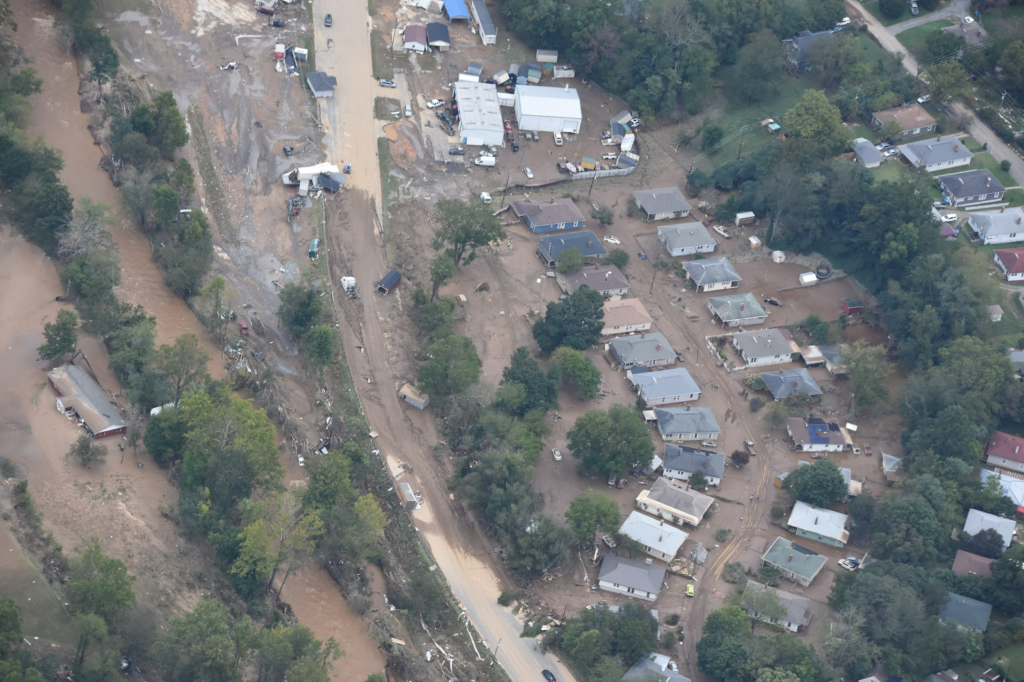
Global supply chains mean that disruption at a single manufacturing plant can lead not only to repair costs and lost revenue for that company, but also to widespread product shortages. For example, Baxter International’s manufacturing plant in Marion, NC was closed for weeks during and after Hurricane Helene, due to extreme flooding. This single plant was responsible for 60% of the United States’ IV solution supply and it didn’t resume full operations for several months. This led to rationing at hospitals throughout the country, with rippling implications across the healthcare industry, affecting patients who rely on Baxter’s outputs. Meanwhile Baxter expected lost sales revenue from the event to be around $200 million and adjusted its full year sales growth forecast downward accordingly.
Figure 1. Hurricane Helene damaged infrastructure, homes, commercial and industrial buildings
Source: NCDOTcommunications, CC BY 2.0 <https://creativecommons.org/licenses/by/2.0>, via Wikimedia Commons
From heatwaves and wildfires to hurricanes, extreme events strain the power grid with deadly and costly consequences. When Hurricane Beryl made landfall in Houston in 2024 over 2 million households and businesses lost power, many for over a week. This outage corresponded with a heatwave in Texas, which wasn’t just uncomfortable, but deadly for some who relied on power for air conditioning or medical devices. CenterPoint Energy, the primary Houston utility, reported that together with Hurricane Francine and Winter Storm Enzo, repair costs from the storm were around $1.3 billion, which will be passed to customers gradually with a surcharge over 15 years.
Weakened Public Health & Ecosystem Services
The public health impacts of climate change also present cascading risks that can carry between work and home. For example, extreme heat threatens worker health and safety both on and off the jobsite. On construction sites, heatwaves increase the risk of accidents, reduce productivity and increase timelines. When workers endure hot temperatures at home it disrupts their sleep, which directly contributes to cognitive impairment at work the next day. Liberty Mutual estimates that US businesses already spend over $58 billion on workplace safety incidents each year.
Meanwhile, when industrial facilities are not adequately prepared for flooding, contaminants are often released into watersheds and ecosystems. Most recent hurricanes led to toxic spills, costing both the business and the community. Flooding during Hurricane Harvey in 2017 led to issues with the refrigeration system at Arkema’s peroxide manufacturing plant in Crosby, Texas, resulting in explosions, evacuations and contamination. Arkema faced a $1.1 million settlement with Harris County and agreed to implement flood prevention measures. This is on top of clean-up fees and ongoing class action lawsuits related to the incidents.
Reduced Long-Term Economic Vitality
When business declines, layoffs or store closures often follow, which in turn tends to reduce immigration or increase emigration, contributing to a cycle of declining tax base, less funds to maintain public infrastructure and less jobs within a community.
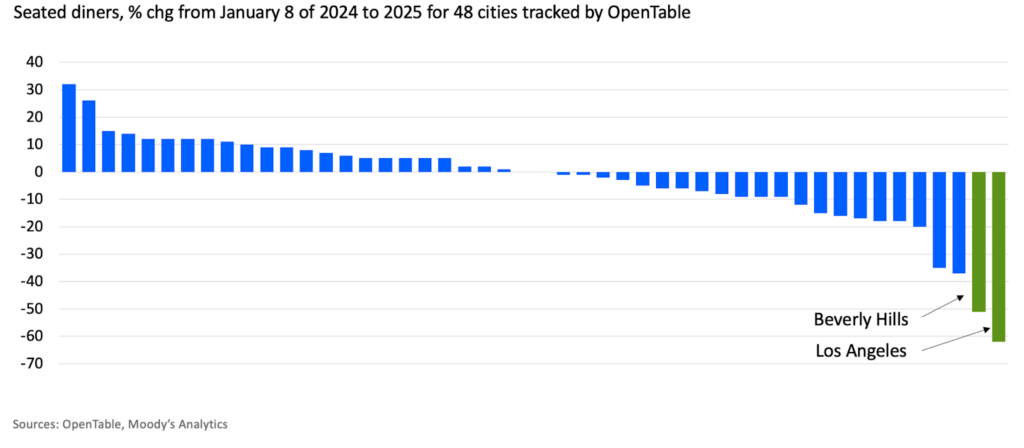
Figure 2. Year over Year Change in Seated Diners Occupancy by City
Source: “Southern California Wildfires are Poised to Make the Worst Kind of History.” Moody’s.
Extreme events often lead to disrupted productivity regionally (Figure 2), with multiple factors informing how quickly activity bounces back. The resilience of the insurance industry also informs the long-term viability of a community, directly contributing to whether or not communities rebuild after a disaster. When payouts don’t come swiftly, premiums soar or insurance coverage is not renewed, residents are less likely to rebuild, contributing to broader challenges in maintaining the tax base, repairing public infrastructure and attracting redevelopment. The negative impacts of extreme events on corporations and communities can interact and compound one another, creating feedback loops of disruption
However, this feedback cycle can be reversed into a positive feedback loop, promoting compounding resilience across all sectors of society. When facilities and supply chains are resilient, negative impacts are minimized and business continuity can enable a company to support the community.
Resilient Businesses Underpin Vibrant Economies and Communities
Continuity in Critical Supplies and Infrastructure
When companies’ own facilities are resilient to extreme events, it allows them to support the community. During Hurricane Helene, Walmart provided services such as water and food distribution, charging and showers in their store parking lots. During the 2025 Los Angeles wildfires Planet Fitness opened its facilities to those affected by the fires, offering showers, chargers, wifi and other amenities. Similarly, U-Haul offered 30 days of free storage for evacuees during the fires.
When power, communication and water infrastructure remains intact the providers enhance their reputation and benefit from stable business, while consumers enjoy continuity in services which allows them to focus on recovery efforts.
Corporations Supporting Social and Environmental Needs
It is also common for corporate foundations to make financial donations to aid efforts during and after disasters, which complements government relief funding, usually moving more quickly. Many companies also have relief funds which they use to support employees, suppliers or community members when they’re affected by natural disasters.
Consumer demand for goods or services can also spur private sector innovation, presenting a business opportunity for companies to fill the demand. For example, the COVID-19 pandemic overlapped with severe wildfire seasons in the Western US, creating demand for advanced and widespread air filters from multiple angles. This helped catalyze rapid development in this space, as companies raced to fill the need with advanced products both for pathogen protection and protection from wildfire smoke.
Corporations can also serve as early innovation adopters, providing market signals that can propel continued technological innovation that everyone benefits from. For example, corporations contributed to the surge in demand for advanced air filtration discussed above, helping propel competition and innovation.
Increased Long-term Economic Vitality
Resilient businesses are key for long-term economic vitality. In this role corporations can partner with other businesses, community-members and governments, contributing property, capital or other resources for broader resilience measures, such as efforts to address urban heat island, or flood control measures that span multiple properties.
As a critical foundation for real estate development, insurers have an opportunity to foster both community and industry resilience. Innovations in risk assessment, policy parameters and property-level resilience can reduce insurers’ payout costs, while minimizing damage to a community. For example, FM global offers clients a resilience credit for implementing relevant resilience measures, hardening a property for wind, flood or wildfire.
This need for innovation is evident across sectors and climate impacts, and presents an opportunity for entrepreneurs and investors. We invest in technologies that help corporations futureproof the infrastructure, workforce and supply chain of today and tomorrow, so that businesses and communities can thrive in a changing climate.