|
|
|
|
|
|
|
|
Tailwind Futures invests in technologies that help corporations futureproof the infrastructure, workforce, and supply chain of today and tomorrow.
|
 |
|
|
From Lab to Market: 4D Printing
|
|
|
In the third installment of our Resilience Game Changers series, we turn to 4D printing. This technology uses additive manufacturing, commonly known as 3D printing, to produce objects capable of changing shape in response to temperature, moisture, or pH, without power, sensors, or human intervention. These adaptive 3-dimensional objects can be described as having a 4th dimension: time.
Three main types of smart materials enable this shape changing: shape memory polymers that snap back to a memorized form when heated, hydrogels that swell when absorbing water, and liquid crystal elastomers that contract on heating.
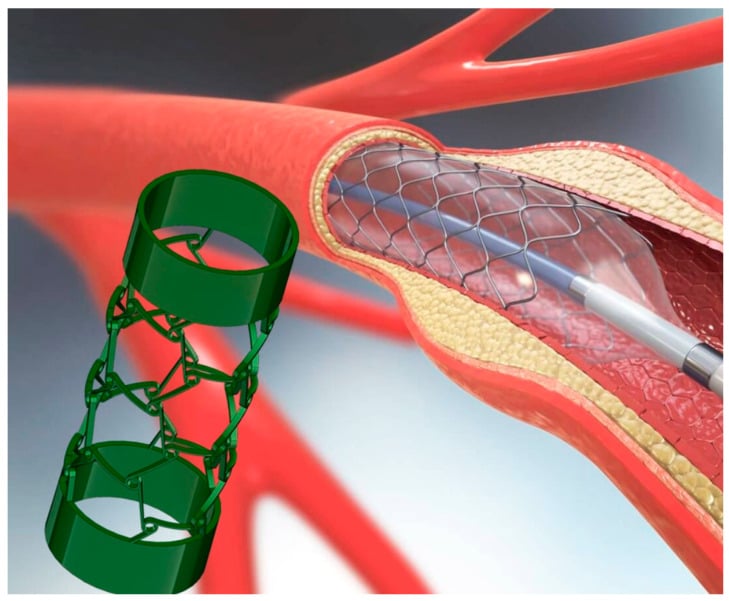
The most advanced climate adaptation applications are in healthcare, where extreme heat puts cardiovascular and kidney disease patients at higher risk and changes their medication needs. Standard medical implants release drugs at preset rates or hold arteries at fixed geometries, regardless of what the body is experiencing. However, researchers at the University of Texas at Austin have demonstrated 4D-printed constructs that self-fold at body temperature and modulate drug release as they change shape, a proof of concept for implants that could automatically adjust dosing during heat events. |
|
|
|
A separate group has developed 4D-printed vascular stents that self-expand at body temperature. Future versions could adapt their geometry to extreme heat-induced vessel changes, reducing artery wall strain linked to clots and heart attacks.
Our forthcoming report on Resilience Game Changers will map the broader landscape of hard-tech academic research and development relevant to adaptation and resilience and examine pathways to commercialization.
|
|
|
|
Reach out to share a technology you think we should feature!
|
|
|
|
Upcoming Events
|
|
From Data to Decisions: Storytelling with Coastal Intelligence
|
|
|
Webinar on Tuesday, May 19 – 1:00 PM – 2:00 PM PT
Next week our portfolio company Hohonu is hosting a webinar announcing Tides+, its new tide prediction model that draws on hyperlocal sensor observations and decades of coastal water level data to produce more accurate tide predictions. The model improves upon existing NOAA tide predictions by 51% for the highest tides, and works with as little as 30 days of local data.
Register here to join the webinar.
|
|
Scaling Resilience: Building and Funding Adaptation Technology
|
|
|
Webinar on Wednesday, May 27 – 9:00AM – 12:00 PM PT
Foley Hoag will be hosting a webinar exploring how adaptation and resilience startups can scale their businesses and navigate the fundraising landscape.
Founding Partner Emilie Mazzacurati will join a great line-up of fellow panelists bringing extensive experience in climate risk and resilience, building entrepreneurial ecosystems, and mobilizing capital for adaptation and resilience solutions:
- Allie Clark, Foley Hoag (Moderator)
- Emilie Mazzacurati, Tailwind Futures
- Lori Collins, GARI Group
- Jamil Wyne, Hazelwood Network
Register here to join the webinar.
|
|
|
|
Insights from Recent Events
|
|
|
|
|
|
All session recordings now live!
|
|
|
Our recap blog shares highlights from our San Fransisco Climate Week event on how technological innovations can mitigate risk and improve returns in real estate. You can also watch the individual session recordings, hearing about new tech for risk assessment and data collection, insurance innovation and more.
|
 |
|
Harnessing Resilience Innovation – DC Climate Week Recap
|
|
|
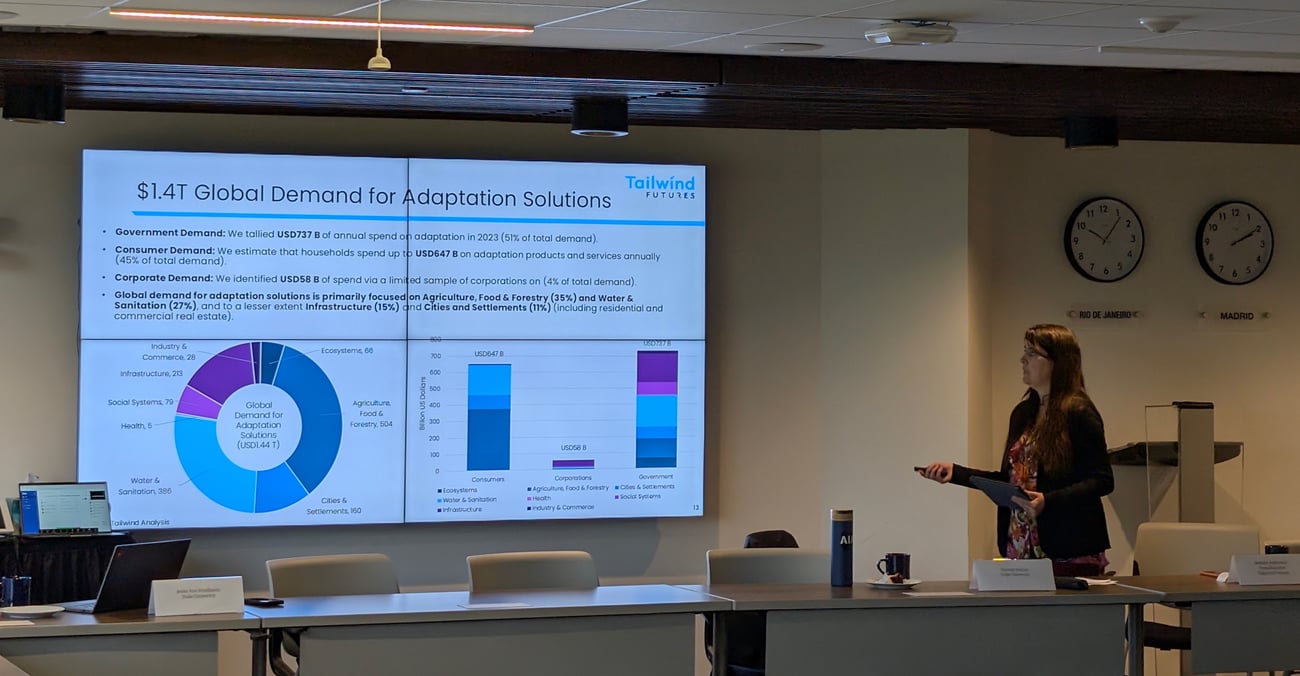
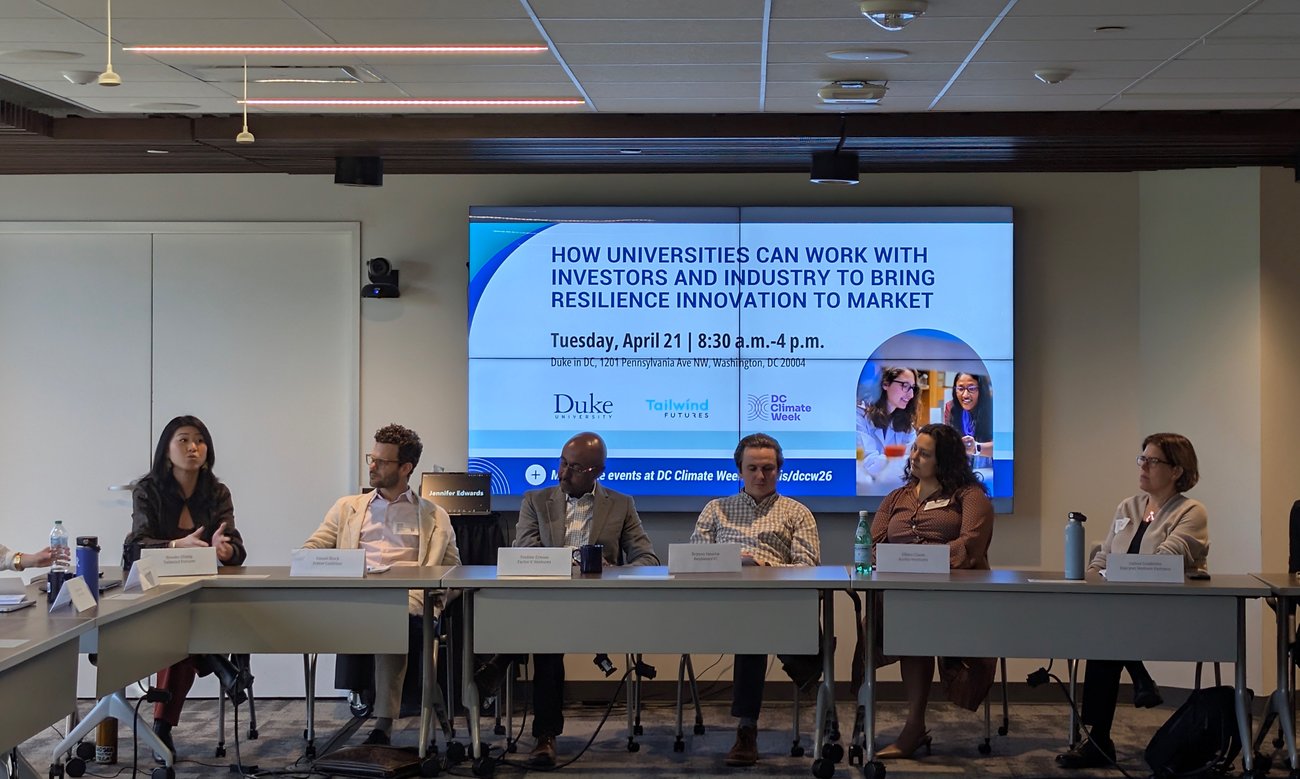
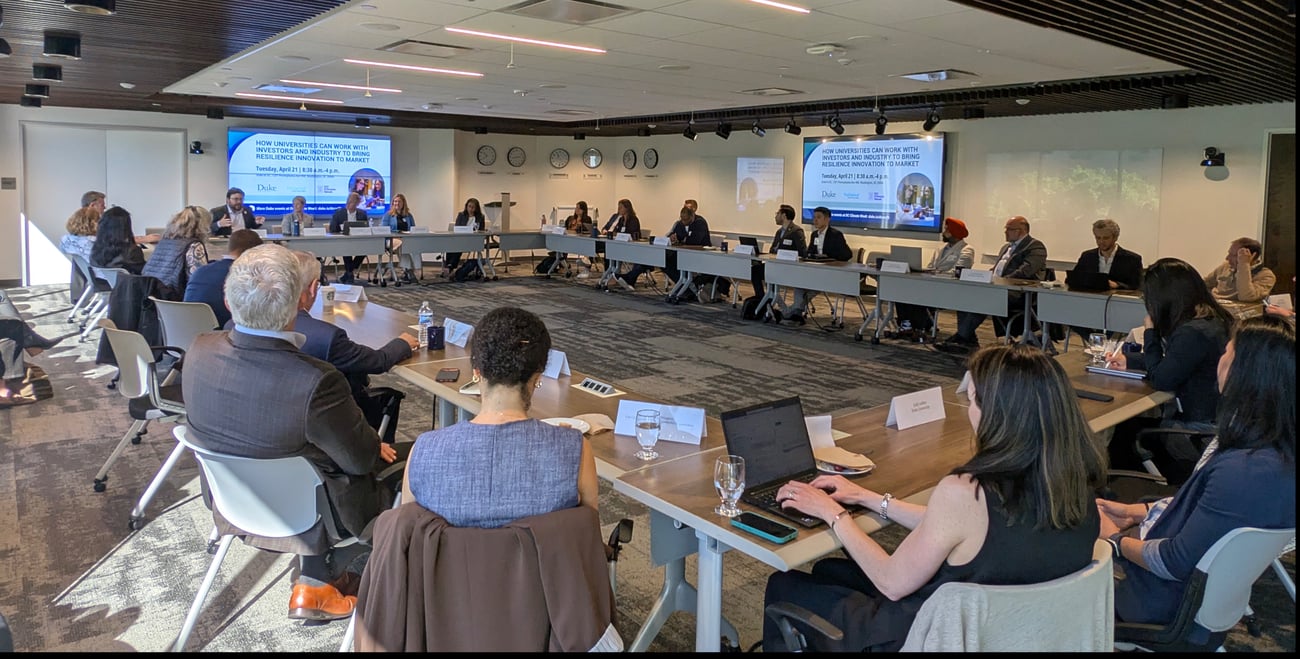
Advances in resilience tech present a huge opportunity for addressing climate impacts and building the market for solutions. Communicating across potential users early on, and building out a systems approach to planning and financing resilience will help boost the impact of technological innovation. Our recent blog unpacks these themes and other key takeaways from DC Climate Week, where Natalie Ambrosio Preudhomme joined several events hosted by Duke University, including one co-hosted by Tailwind Futures focused on bringing university research to market.
|
|
|
|
|
|
Natalie presented our research on the the demand for adaptation solutions (left) and Brooke spoke on the investor’s perspective panel (center) at the workshop, “How Universities Can Work With Investors and Industry to Bring Resilience Innovation To Market” (right).
|
Read the Blog
|
|
|
|
Accelerators, Fellowships & Prizes
|
|
|
The Cartier Women’s Initiative Science & Technology Pioneer Award supports women-led deep tech startups with a year-long fellowship including INSEAD programming, individual coaching, and a global awards week. Applicants must be pre-Series A, with at least a proof of concept (TRL 4), and must not have been commercializing their product for more than five years. Climate adaptation companies are a strong fit given the SDG alignment requirement. Apply by June 16, 2026.
|
|
Job Openings at Our Portfolio Companies
|
|
|
|
Share a Market Update
|
|
|
|
|
|
|
|
|
|