

Protecting workers from extreme heat has become a top priority for corporations. Germany experienced an estimated 16,000 heat-related deaths during summer 2026, France recorded over 7300 excess deaths from extreme heat by mid August and the US recorded around 145,321 heat-related emergency department visits as of September 10, 2026. Heat-related incidents in the workplace are similarly on the rise, with worse exposure for workers in certain industries because of the work environment or equipment they use or wear.
Heat tech solutions present an opportunity to safeguard workers’ health and safety, while reducing financial losses as heat records are repeatedly set. As a Chief Sustainability Officer of a large company put it, making sure workers can work when it is hot is increasingly important for companies’ “right to exist.” But to make the case to their CEOs and CFOs, corporate leaders need the numbers that prove that heat tech solutions also protect a company’s “right to win.”
Quantifying the Value of Heat Solutions
From heavy industry or construction to utilities, energy or agriculture, executives know the value of heat tech solutions intuitively but often struggle to adequately quantify it in financial terms. Data helps prove that solutions for extreme heat influence the bottom line and this data is available.
Attracting and Retaining Employees
In an era defined by labor shortages for many of the industries challenged by worker exposure to extreme heat, heat solutions can be a valuable differentiator for workers and unions carefully selecting their next employers and jobsites. Heat tech can also help retain these workers as conditions become more extreme.
In addition to attracting and retaining workers, there are two major categories of metrics that can help communicate the value of heat solutions to executive teams.
Intentionally capturing relevant data can help make the case for and track the value-add of heat tech solutions :
- Productivity
- How much productivity is lost due to heat?
- How much productivity can be recovered by adopting heat solutions?
- Cost Avoidance
- How much insurance cost is avoided by adopting heat solutions?
- How much workforce cost is avoided by adopting heat solutions?
Calculating Productivity
Worker productivity losses of $100 billion in the US in 2020 will double due to heat in 2030 and rise to $500 billion by 2050. When it comes to productivity, organizations need to understand the productivity of their workforces at baseline before they can consider how heat (or lack of heat) will influence the productivity of a future hour of labor.
Different companies have different metrics for productivity, from agriculture (ex. tons of sugarcane harvested per hour) to construction (ex. number of drywall sheets hung per hour) and different economics that make their businesses tick. This makes it important to crunch productivity numbers with a business’ specific work tasks, workforce, geography and objectives in mind.
In a 2026 presentation, a major construction firm reported 12,000 hours of labor lost on one construction site in Texas over four months due to heat, presenting a startling and noteworthy example of the insights that tracking heat and productivity can reveal.
Understanding The Full Picture
Often overlooked, the cost of heat goes far beyond productivity losses. For an employer, these costs are expensive and can include but may not be limited to the following:
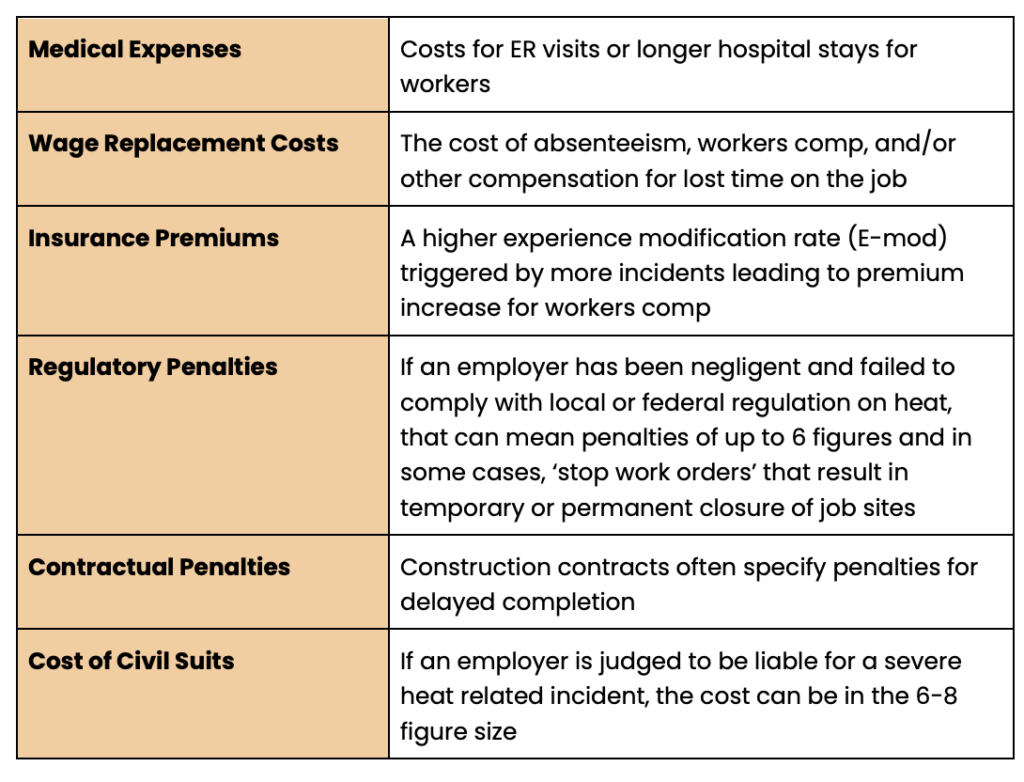
Role of Heat Tech
Considered together with appropriate policies and procedures to manage heat exposure on worksites, heat tech innovation offer opportunities to protect workers, boost competitiveness and avoid major financial losses, creating conditions for market advantage.
Heat and the Body
When it comes to keeping a human body safe from the cascading negative impacts of heat, there’s a physiological math equation to consider. This equation has to do with how much heat a given product removes from a human body.
As humans get hot, their bodies absorb energy from their external environment. The body has natural methods for cooling itself that it quickly deploys in these scenarios, moving blood towards the skin to dissipate heat (vasodilation) and sweating. These methods work, but only to a certain extent. When the body’s heat load rises too quickly, these avenues for cooling can’t keep up with the energy being dumped into the body – like sailors trying to bail out a sinking boat with a thimble.
This issue compounds as you increase the rigor of work and as wet bulb globe temperature (WBGT) rise. WBGT is a measure of heat stress in sunlight that considers temperature, humidity, wind speed, sun angle and cloud cover. Heat load is the total burden from heat the body experiences, including from heat exposure, exertion and insulation. The chart below shows the excess heat load in the body (above the body’s natural cooling capability) under heavy, moderate and light work. At a very high WBGT even light work can push heat load over the body’s cooling ability.
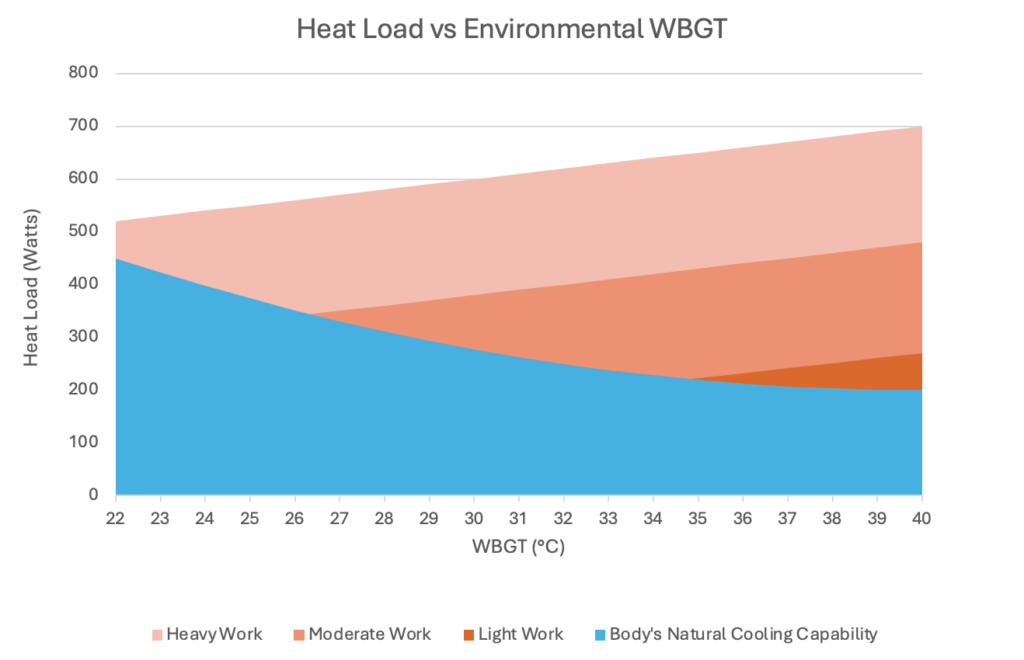
Credit: La Isla Network
This is where the opportunity for heat tech becomes the most important. How can new technologies assist the human body with this dangerous math problem?
The Landscape of Heat Tech Solutions
At Tailwind Futures, we look at heat tech solutions capable of positioning companies to win. To do so, these solutions must do one or more of three things:
- prevent heat from entering the body
- increase the body’s ability to shed heat
- reduce the impact of heat on internal organs by stopping heat-triggered physical inflammation.
Another set of heat technologies are focused on cooling the building or work environment and can be a critical part of the answer, but this analysis focuses on solutions for the workers themselves.
We break workers’ health & safety heat solutions into the three broad categories of sensing & autonomous tech; advanced materials & engineered solutions; and risk transfer.
Sensing & Autonomous Tech: Prevention
Most products in this category address the challenge of reducing heat input into the body by monitoring core body temperatures and leveraging recommended breaks, shade, water or other preventative interventions to prevent workers from getting too hot. For example, VigiLife makes wearable sensors connected to a software providing predictive alerts based on personal information and real-time readings. Another company, Biodata bank, created a device that simply slides on like a watch and alerts the wearer if the body starts to get dangerously hot, but without sending personal health metrics into an employer-managed digital system.
Advanced Materials & Engineered Solutions
This second category of solutions focus on helping the body shed excess heat, often through wearable technology. There’s a range of these approaches, including passive cooling, phase change and other advanced materials that help pull heat from the body. There are also a range of active cooling wearables, including personal fans such as Mexar’s device, which supports the body’s natural evaporative cooling and active cooling garments like Thermobionics’ battery-powered shirt. Our portfolio company Cyrgogenx has invented a portable device to treat heat stroke by lowering core body temperature back to safe levels.This curative device, currently undergoing FDA review, helps prevent deaths when preventative approaches fail.
Risk Transfer Solutions
Insurtech offers approaches for companies to reduce the losses they incur from the costs listed above related to productivity losses, medical expenses, wage replacement and insurance. For example Suyana offers parametric insurance for a range of climate hazards, including a policy that triggers when sustained temperatures reach a pre-defined level. The HERInsura Initiative is a philanthropic insurance solution focused on informal women workers who bear the brunt of extreme heat in many places. The solution combines parametric insurance with cash payouts and risk reduction approaches. By co-designing effective risk reduction measures, such as shade covers in markets, protective gloves for use with metal agriculture equipment, and water flasks, this approach helps limit the need for risk transfer to only the most extreme situations, and could be replicated for workers elsewhere or help cover lost wages for workers in certain industries.
Evaluating Technology for Impact
Tailwind Futures focuses on heat tech startups presenting solutions that are fit for purpose and right-sized for long-term heat projections.
For wearable solutions, we are dedicated to ensuring that new products focus on solving the critical physiological math problem above, reducing core body temperature, rather than just making the wearer feel cool. Third party validation of exactly how much of the energy burden of heat a product can relieve from a human body is an important step on the path to commercialization.
Successful startups in this space will have a product that solves a specific painpoint, rather than a technology that contributes part of a solution. We look for multiple potential user segments with different timelines, presenting a robust and manageable opportunity for scale.
Startups should also identify and consider how demographics and comorbidities influence the efficiency of solutions, and examine how potential exposure to heat outside of work influences vulnerability during work hours. Addressing these factors early during product development helps identify and prevent potential maladaptation concerns.
A successful team brings it all together, combining technical expertise with deep insight in the industry of the target customer. Reach out to us to pitch your solution that safeguards health and safety while helping companies’ maintain their right to win.